

A roof replacement is a decision most homeowners make only once or twice in the time they own a house, which makes the material choice worth slowing down for. Metal and asphalt shingles come up in nearly every conversation, and the honest answer is that neither one wins across the board. The right pick depends on your budget, how long you plan to stay in the home, and what your roof has to handle in weather.
The Difference in One Minute
Asphalt shingles are the budget-friendly option. They cost less to buy and less to install, they are quieter in the rain, and they are straightforward for any qualified crew to work with. Metal roofing flips those strengths. It costs more on the front end, but it lasts longer, stands up better to heavy storms, and asks for less upkeep over the years.
Published comparisons tend to frame it the same way: metal roofing costs roughly two to three times more upfront than asphalt shingles and lasts roughly two to three times longer. That trade-off is the whole decision in miniature. Everything else, from noise to resale appeal to how repairs get handled, is a detail hanging off those two facts.
Upfront Cost of Metal Roofing vs. Asphalt Shingle
Cost guides place complete asphalt roofing somewhere between $80 and $250 per 100 square feet, which is the roofing unit known as a square. Metal shingle pricing starts around $200 per square and can exceed $1,000 per square depending on the material and profile. Another common way of describing the same gap is that metal generally costs more per square foot than asphalt alternatives, sometimes by a factor of two or three.
Those are ranges pulled from published cost guides, and your actual quote will move based on roof pitch, how many old layers have to come off, valleys and penetrations, and the metal profile you select. Treat any figure you find online, including these, as a starting point to compare against a written local estimate rather than a final price.
Factor | Asphalt shingles | Metal roofing |
|---|---|---|
Upfront cost | Lower, roughly $80 to $250 per square in published guides | Higher, starting near $200 per square and able to exceed $1,000 |
Typical service life | Commonly cited between 15 and 30 years | Frequently described as 50 plus years or decades of service |
Storm durability | More vulnerable to heavy storm damage | More durable and less likely to be damaged in a heavy storm |
Noise in rain | Quieter | Less quiet than asphalt |
Ongoing upkeep | More attention needed as the roof ages | Easier to maintain |
Environmental profile | Replaced more often over the life of the home | Described as more eco-friendly |
Lifespan and Long-Term Value
The lifespan gap is where metal starts to justify its price. Asphalt shingles are often rated to last 15 to 25 years, with other comparisons putting the range at 20 to 30 years or less depending on shingle grade, ventilation, and climate. Metal roofing, by contrast, is consistently described as lasting 50 years or more, or simply as lasting decades.
Run the math at the household level and the picture gets clearer. If you plan to stay in your home for 25 or 30 years, you may pay for two asphalt roofs during that stretch. One metal roof is designed to outlast that window. If you expect to sell in five to ten years, the math shifts the other way, and the lower upfront cost of asphalt becomes much harder to argue against.
Durability and Storm Performance
Metal sheeting is more durable than shingle tabs and less likely to be damaged by a heavy storm. That matters in North Georgia, where a single severe weather system can lift tabs, strip granules, and leave you filing a claim. Asphalt shingles do their job well in normal conditions, but their surface granules wear down over time, and that wear is what eventually shortens the roof's life.
Durability is not the same as invincibility, though. Metal can still be dented by large falling limbs or hail, and a poor installation can create problems on any material. The advantage is that in most storm scenarios, a properly installed metal roof comes through with less structural damage than shingles would.
Noise and Everyday Comfort
Asphalt roofs are quieter. That is the plain trade-off, and anyone who has spent a rainy afternoon under a thin metal panel can tell you why. The sound difference is most noticeable during heavy rain and hail. Proper roof decking and underlayment affect how much sound transfers into the attic and living space, so the gap narrows with a well-built assembly, but shingles still have the edge on quiet.
If you have bedrooms directly under the roof plane or you are sensitive to rain noise, this is a real factor rather than a minor footnote. It will not show up in a cost estimate, but you will notice it every storm season.
Maintenance, Repairs, and Parts
Metal roofing is generally easier to maintain. There are no granules to shed, and fewer small failure points to chase as the years pass. Asphalt shingles need more attention as they age, and while individual tabs and small sections can often be repaired, repeated patch work adds up.
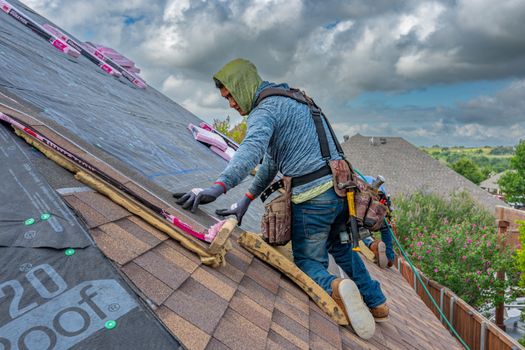
One practical point homeowners rarely consider: color and profile matching. When a repair is needed years later, matching an aged shingle field can be difficult because the old shingles will have weathered to a different tone than new ones. Metal has its own version of this issue if a panel or finish is discontinued, so it pays to ask your contractor how future repairs would be handled with either material before you commit.
Environmental Footprint
Metal roofing is described as more eco-friendly than asphalt, largely because it is replaced far less often over the life of a home. Fewer tear-offs mean fewer shingles heading to a landfill and fewer full roof replacements across the decades you own the property. Asphalt shingles are not recycled at high rates in most markets, so each replacement cycle creates another pile of old material.
If reducing waste over the long term matters to you and you can absorb the higher upfront cost, metal has a clearer story. If budget is the binding constraint, asphalt remains the practical choice for a lot of households.
Style Options and Curb Appeal
Asphalt gives you more choices than most people expect. Shingle lines range from basic three-tab to dimensional and luxury profiles, which means you can change the look of a home considerably without leaving the asphalt category. Dimensional and luxury shingles can mimic the depth and shadow lines of more expensive materials at a fraction of the price.
Metal has a different visual character, and it tends to read as a deliberate design choice. Some homeowners love that. Others prefer the traditional look of shingles. Neither answer is wrong, and the decision usually comes down to what fits the rest of your exterior rather than any performance issue.
How to Decide for a North Georgia Home
Start with a realistic timeline. If this is your forever house, the long service life of metal carries more weight. If you are likely to move within a decade, the lower entry cost of asphalt usually wins on pure numbers.
Then look at your roof's exposure. Homes surrounded by mature hardwoods in Habersham or Rabun County see more debris, more shade, and more organic growth on the roof surface. Homes out in the open in Hall County catch more direct sun and more wind-driven rain. Those conditions influence how either material will age on your specific property.
Finally, get an honest inspection before you decide anything. Division Kangaroof has served Cornelia, Gainesville, and the surrounding North Georgia communities since 2008 as a family-owned contractor, and we install and service both asphalt shingle and metal roofing systems. We will give you a straight read on your roof's condition, explain what each material would mean for your home, and let you make the call without pressure. We will never upsell you into a material your roof does not need.
Questions Worth Asking Before You Sign
What is the expected service life of this specific product, not the category in general?
What does the written estimate include, and what would add cost later?
How would a future repair be handled if this color or profile is discontinued?
What is the workmanship warranty, and what does the manufacturer warranty actually cover?
Does my roof structure, pitch, or ventilation change the recommendation?
Ask these before you compare two bids side by side. A lower number that excludes necessary work is not really a lower number, and a higher number that includes items you do not need is not automatically better quality.
Frequently Asked Questions
Which lasts longer, metal roofing or asphalt shingles?
Metal lasts longer in essentially every published comparison. Asphalt shingles are typically rated for 15 to 30 years depending on grade and climate, while metal roofing is commonly described as lasting 50 years or more. Installation quality, attic ventilation, and local weather all affect the real number, so treat those ranges as guidance rather than a guarantee.
Is a metal roof worth the higher upfront cost?
It depends on how long you keep the house. Metal costs roughly two to three times more upfront and lasts roughly two to three times longer, so the value shows up over decades rather than in year one. If you plan to stay long term, the numbers work. If you expect to sell soon, asphalt usually makes more financial sense.
Are metal roofs noisy when it rains?
They are louder than asphalt shingles, which are noticeably quieter. The difference is most obvious during heavy rain or hail. Roof decking and underlayment affect how much sound carries into the attic and living space, so a well-built assembly reduces the noise, but it will not disappear entirely compared with a shingle roof.
How do I choose between the two for my home?
Weigh three things: how long you plan to stay, what your budget allows right now, and how your roof is exposed to sun, wind, and tree cover. Then get an inspection so the decision is based on your roof's actual condition instead of a general rule. Both materials perform well when installed correctly.